Page 62 [62]


OCR
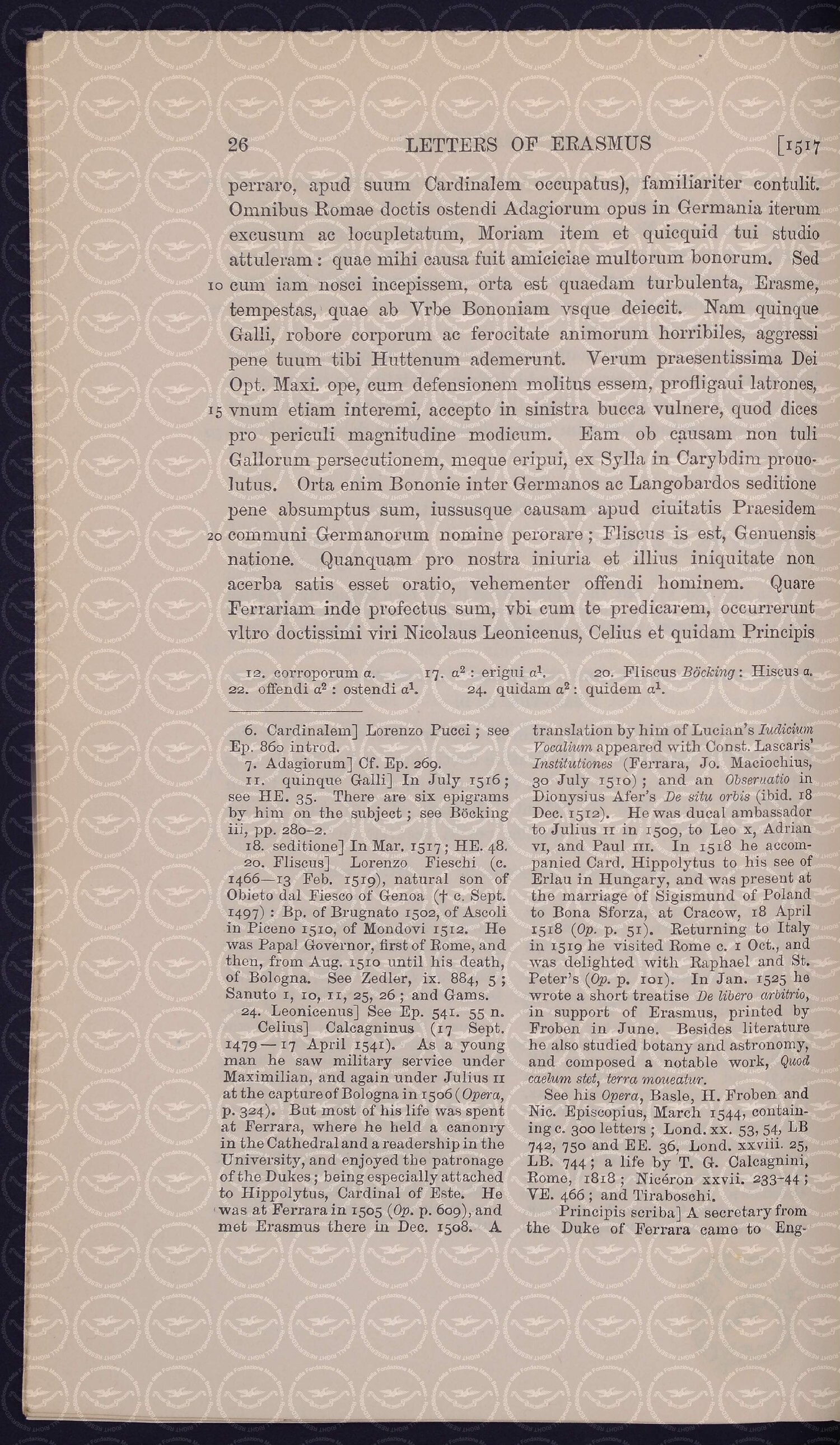
22. offendi a? : ostendi al. 6. Cardinalem] Lorenzo Pucci ; see Ep. 86o introd. 7. Adagiorum] Cf. Ep. 269. IT. quinque Galli] In July 1516; see HE. 35. There are six epigrams by him on the subject ; see Bücking iii, pp. 280-2. 18. seditione] In Mar, 1517; HE. 48. 20. Fliscus] Lorenzo Fieschi (c. 1466—13 Feb. 1519), natural son of Obieto dal Fiesco of Genoa (+ ec. Sept. 1497) : Bp. of Brugnato 1502, of Ascoli in Piceno 1510, of Mondovi 1512. He was Papal Governor, first of Rome, and then, from Aug. 1510 until his death, of Bologna. See Zedler, ix. 884, 5; Sanuto 1, ro, 11, 25, 26; and Gams. 24. Leonicenus] See Ep. 541. 55 n. Celius] Caleagninus (17 Sept. 1479—17 April 1541). As a young man he saw military service under Maximilian, and again under Julius IL at the captureof Bologna in 1506 (Opera, p- 324). But most of his life was spent at Ferrara, where he held a canonry in the Cathedraland a readership in the University, and enjoyed the patronage of the Dukes; being especially attached to Hippolytus, Cardinal of Este. He was at Ferrara in 1505 (Op. p. 609), and met Erasmus there in Dec. 1508. A translation by him of Lucian’s Iudicium Vocalium appeared with Const. Lascaris’ Institutiones (Ferrara, Jo. Maciochius, 30 July 1510); and an Obseruatio in Dionysius Afer’s De situ orbis (ibid. 18 Dec. 1512). He was ducal ambassador to Julius 1 in 1509, to Leo x, Adrian vi, and Paul mz. In 1518 he accompanied Card. Hippolytus to his see of Erlau in Hungary, and was present at the marriage of Sigismund of Poland to Bona Sforza, at Cracow, 18 April 1518 (Op. p. 51). Returning to Italy in 1519 he visited Rome ec. 1 Oct., and was delighted with Raphael and St. Peter’s (Op. p. ror). In Jan. 1525 he wrote a short treatise De libero arbitrio, in support of Erasmus, printed by Froben in June. Besides literature he also studied botany and astronomy, and composed a notable work, Quod caelum stet, terra moueatur. See his Opera, Basle, H. Froben and Nic. Episcopius, March 1544, containing c. 300 letters ; Lond. xx. 53, 54, LB 742; 750 and EE. 36, Lond. xxviii. 25, LB. 744; a life by T. G. Calcagnini, Rome, 1818; Nicéron xxvii. 233-44; VE. 466; and Tiraboschi. Principis scriba] A secretary from the Duke of Ferrara came to Eng