
Page 41 [41]

OCR
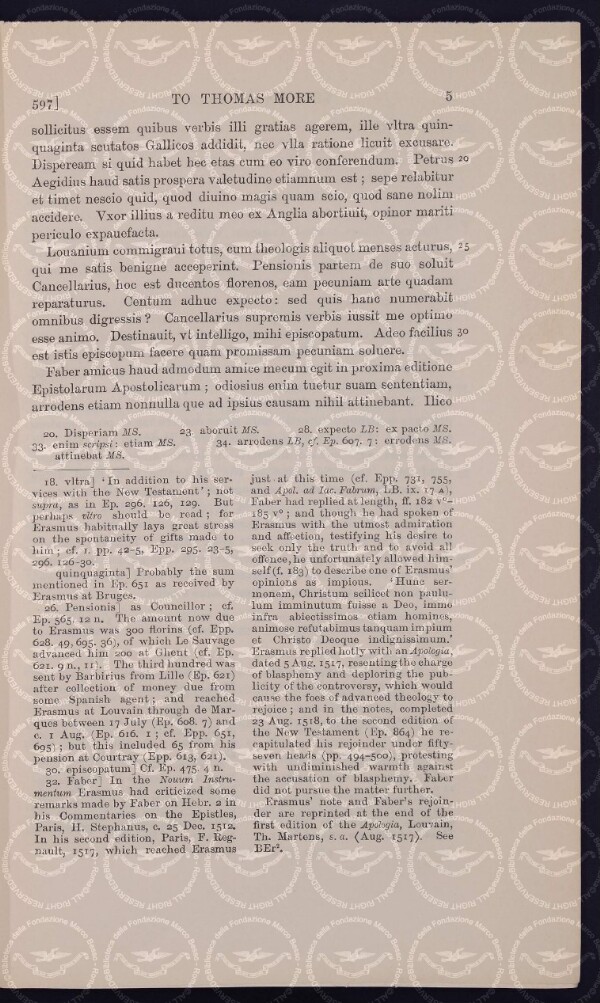
597] TO THOMAS MORE 5 sollicitus essem quibus verbis illi gratias agerem, ille vltra quinquaginta scutatos Gallicos addidit, nec vlla ratione licuit excusare. Dispeream si quid habet hec etas cum eo viro conferendum. Petrus Aegidius haud satis prospera valetudine etiamnum est ; sepe relabitur et timet nescio quid, quod diuino magis quam scio, quod sane nolim accidere. Vxor illius a reditu meo ex Anglia abortiuit, opinor mariti periculo expauefacta. Louanium commigraui totus, cum theologis aliquot menses acturus, qui me satis benigne acceperint. Pensionis partem de suo soluit Cancellarius, hoc est ducentos florenos, eam pecuniam arte quadam reparaturus. Centum adhue expecto: sed quis hance numerabit omnibus digressis? Cancellarius supremis verbis iussit me optimo esse animo. Destinauit, vt intelligo, mihi episcopatum. Adeo facilius est istis episcopum facere quam promissam pecuniam soluere. Faber amicus haud admodum amice mecum egit in proxima editione Epistolarum Apostolicarum ; odiosius enim tuetur suam sententiam, arrodens etiam nonnulla que ad ipsius causam nihil attinebant. Ilico 23. aboruit MS. 28. expecto LB: ex pacto MS. 20. Disperiam MS. 33. enim scripsi: etiam MS. attinebat MS. 18. vltra] ‘In addition to his services with the New Testament’ ; not supra, as in Ep. 296. 126, 129. But perhaps vlro should be read; for Erasmus habitually lays great stress on the spontaneity of gifts made to him; cf. 1. pp. 42-5, Epp. 295. 23-5, 296. 126-30. quinquaginta] Probably the sum mentioned in Ep. 651 as received by Erasmus at Bruges. 26. Pensionis] as Councillor; cf. Ep. 565. 12 n. The amount now due to Erasmus was 300 florins (cf. Epp. 628. 49, 695. 36), of which Le Sauvage advanced him 200 at Ghent (cf. Ep. 621.9n.,11). The third hundred was sent by Barbirius from Lille (Ep. 621) after collection of money due from some Spanish agent; and reached Erasmus at Louvain through de Marques between 17 July (Ep. 608. 7) and c. 1 Aug. (Ep. 616. 1; cf. Epp. 651, 695); but this ineluded 65 from his pension at Courtray (Epp. 613, 621). 30. episcopatum] Of. Ep. 475. 4 n. 32. Faber] In the Nouum Instrumentum Erasmus had criticized some remarks made by Faber on Hebr. 2 in his Commentaries on the Epistles, Paris, H. Stephanus, c. 25 Dec. 1512. In his second edition, Paris, F. Regmault, 1517, which reached Erasmus just at this time (cf. Epp. 731, 755; and Apol. ad Iac. Fabrum, LB. ix. 17 4), Faber had replied at length, ff. 182 y°— 185 v°; and though he had spoken of Erasmus with the utmost admiration and affection, testifying his desire to seek only the truth and to avoid all offence, he unfortunately allowed himself (f. 183) to describe one of Erasmus’ opinions as impious. ‘Hunc sermonem, Christum scilicet non paululum imminutum fuisse a Deo, immo infra abiectissimos etiam homines, animose refutabimus tanquam impium et Christo Deoque indignissimum.’ Erasmus replied hotly with an Apologia, dated 5 Aug. 1517, resenting the charge of blasphemy and deploring the publicity of the controversy, which would cause the foes of advanced theology to rejoice ; and in the notes, completed 23 Aug. 1518, to the second edition of the New Testament (Ep. 864) he recapitulated his rejoinder under fiftyseven heads (pp. 494-500), protesting with undiminished warmth against the accusation of blasphemy. Faber did not pursue the matter further. Erasmus’ note and Faber’s rejoinder are reprinted at the end of the first edition of the Apologia, Louvain, Th. Martens, s.a. (Aug. 1517). See BEr’. 20
